

Electric Pole Height Standards for Distribution Networks
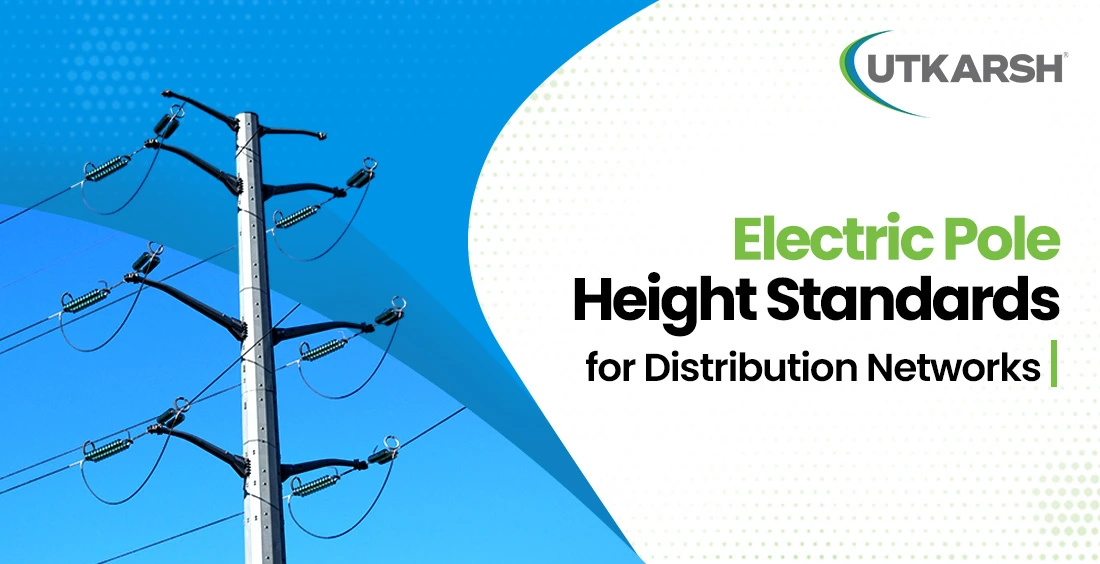
Modern power grids rely on strong, standardized infrastructure to transmit electricity safely and efficiently across urban, suburban, and rural environments. At the heart of this grid is the humble electric pole, a structural backbone designed to support overhead conductors, transformers, and distribution equipment.
Choosing the right electric pole height and specification is not just a matter of structural engineering; it is critical for ensuring ground clearance compliance, public safety, and long-term network reliability.
As a leading utility support electric pole manufacturer, Utkarsh India Limited delivers high-performance galvanized electric poles engineered to meet strict Indian and international standards.
Why Electric Pole Height Standards Matter
Determining the standard height of an electric pole in a power distribution network depends on several key factors:
- Voltage Class: Higher voltage distribution lines (e.g., 11 kV or 33 kV) require greater ground clearance to prevent electrical flashover compared to low-tension (LT) lines.
- Terrain and Location: Pole heights vary depending on whether the distribution route passes over highways, railway tracks, pedestrian pathways, or agricultural fields.
- Environmental Factors: Overhead line sag caused by thermal expansion during heavy loads or hot weather must be factored in so lines never drop below safe ground clearance limits.
- Structural Load: Adding cross-arms, transformers, switchgear, or multi-circuit configurations increases physical loading, requiring specific pole heights and embedment depths.
By adhering to rigorous electric pole standards like IS-2713/80 (Part 1 to 3), utility providers ensure uniform structural strength, predictable deflection limits, and safety across their distribution networks.
Specifications of Utkarsh India’s Galvanized Electric Poles
Utkarsh India, a leading steel fabrication company, manufactures high-grade polygonal steel distribution poles designed to replace conventional concrete (PPC/PSC) or Rolled Steel Joist (RSJ) poles with superior, longer-lasting alternatives.
| Parameter / Feature | Utkarsh India Technical Standard |
|---|---|
| Material Sourcing | Premium steel from top producers like SAIL and TATA Steel |
| Manufacturing Standard | Conforms strictly to IS-2713/80 (Parts 1 to 3) |
| Corrosion Protection | Hot-dip galvanized with a minimum zinc coating of 65 µm to 86 µm |
| Wind Load Capacity | Engineered to withstand wind speeds up to 300 km/h |
| Circuit Compatibility | Supports single-circuit, double-circuit, and multi-circuit systems (AC & DC) |
| Annual Production Capacity | 2,50,000 poles per year |
Why Galvanized Steel Poles Outperform Traditional Options
Compared to traditional concrete or timber poles, steel utility structures offer distinct advantages for distribution network engineers:
- High Ductility & Safety: Steel is inherently ductile—it tends to bend under extreme mechanical overload rather than snap abruptly. This significantly reduces the risk of catastrophic grid failure during natural disasters.
- Superior Corrosion Resistance: Utkarsh India’s hot-dip galvanized coating (65 µm to 86 µm) shields the steel structure against moisture, coastal air, and soil chemicals, dramatically extending service life with minimal maintenance.
- Longer Span Lengths: Due to uniform material strength throughout the structure, steel poles permit longer span lengths between poles, reducing overall project hardware costs.
- Modular Construction for Easy Transport: Featuring modular tubular and polygonal section designs, these poles are easy to transport and deploy rapidly across challenging or remote terrains.
Quality Assurance & In-House Testing
To ensure every electric pole deployed meets strict field requirements, Utkarsh India subjects its distribution poles to comprehensive in-house mechanical testing:
- Drop Test: Evaluates shock resistance and structural integrity under sudden impact loads.
- Deflection Test: Measures structural bending under maximum operational line tension to ensure serviceability limits are maintained.
- Permanent Set Test: Guarantees the pole returns to its original vertical alignment without permanent deformation after stress release.
Also Read: A Guide to Choosing the Right Electric Pole for Utility Projects
Frequently Asked Questions
1. What are the standard standards followed for steel electric poles in India?
Utkarsh India’s power distribution poles strictly conform to IS-2713/80 (Parts 1 to 3) standards, ensuring reliable load-bearing capacity, quality materials, and structural safety.
2. Why is hot-dip galvanization important for electric poles?
Hot-dip galvanizing applies a thick protective layer of zinc (65 µm to 86 µm on Utkarsh poles) that prevents rust and environmental degradation. This significantly extends the operational lifespan of the pole even in harsh weather or coastal environments.
3. Can Utkarsh India supply electric poles customized to specific project heights?
Yes. Utkarsh India offers customizable pole heights, dimensions, and configurations to accommodate specific distribution line voltages, ground clearance needs, and multi-circuit layouts.
4. What wind speed can Utkarsh India distribution poles withstand?
Utkarsh India’s polygonal galvanized electric poles are structurally engineered to withstand extreme weather conditions, including high wind speeds up to 300 km/h.